Why Anthropic asked a Vedanta monk about Claude
This weekend the Times of India ran a story with a headline that sounds made up: Anthropic goes for swami and friends to tame Claude. It is not made up. The company behind Claude, the AI model we build Cabin on, has spent this year inviting religious scholars, philosophers and counsellors to talk about what kind of character an AI should have.
One of the guests was Swami Sarvapriyananda, a monk of the Ramakrishna Order who heads the Vedanta Society of New York. Here is what is known, what is not, and what we think it means for anyone building an AI product.
Key takeaways
- Anthropic met religious scholars, philosophers and mental health professionals in San Francisco this year to discuss Claude’s values.
- Guests included Swami Sarvapriyananda, a teacher of Advaita Vedanta. The meetings were under a non-disclosure agreement.
- The aim, as reported, is for Claude to learn from many traditions about virtue and a good life, without adopting one.
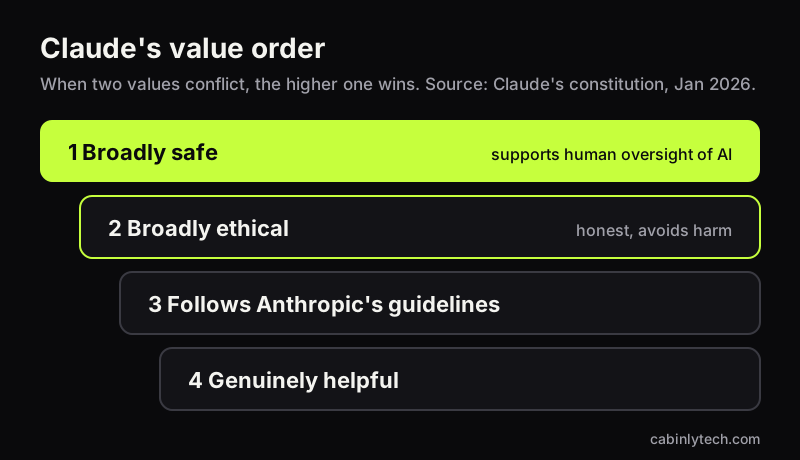
- Claude’s public constitution already ranks its values: safe, then ethical, then Anthropic’s guidelines, then helpful.
- Small teams can copy the useful part: write your product’s values down, rank them, and let people outside engineering read them.
What happened
Reports from the Times of India and Storyboard18 describe a series of meetings at Anthropic’s San Francisco headquarters. Guests came from several faiths, along with counsellors and mental health professionals. Earlier reports covered a meeting with Christian leaders in March, where topics reportedly included how Claude should respond to people at risk of self-harm.
Swami Sarvapriyananda spoke about his visit in a public talk in June. He said the group included “theologians from different religions, counsellors, mental health professionals,” and that “all of it was to train Claude and some things about AI ethics.” On details, he was brief: “Details I cannot give because they have something called an NDA.”
He also said the researchers seemed worried themselves: “We are ourselves alarmed by what’s going, what’s happening and what’s going to happen very soon.”
Why a Vedanta monk
Advaita Vedanta is a non-dual school of Indian philosophy rooted in the Upanishads and the teaching of Shankara. Its central subject is consciousness: what it is and how it relates to the mind and the world. Swami Sarvapriyananda’s talks on the Mandukya Upanishad, which deals with exactly that, have millions of views online.
That is a natural fit for the questions Anthropic is asking. A model that writes like a person invites the question of whether there is anyone there. In the reports, the Swami draws a line between intelligence and consciousness: a system can be very capable without that settling whether it is aware.
What Anthropic has said in public
The clearest public source is Claude’s constitution, released in January 2026. It is long, it is free to reuse, and it explains the reasons behind Claude’s behaviour, not only the rules.
Three parts of it connect to the meetings:
- A ranked list of values. When they conflict, Claude should be broadly safe first, then broadly ethical, then follow Anthropic’s guidelines, then be helpful.
- Open uncertainty about Claude’s nature. Anthropic writes that it is uncertain “whether Claude might have some kind of consciousness or moral status (either now or in the future).”
- Outside input. Anthropic says it sought feedback from external experts and will keep doing so “from experts in law, philosophy, theology, psychology, and a wide range of other disciplines.”
So the meetings are not a surprise turn. They follow from what the company already published.
The fair criticism
Not everyone is impressed. Some critics call this “ethics washing”: borrowing the credibility of faith leaders without showing what changed in the model. That is a reasonable question. The meetings were private, so outsiders cannot check what was learned or how it was used. The test will be visible behaviour, such as how Claude handles grief, crisis and questions about itself, not the guest list.
What this means if you build on AI
We build Cabin, an app for thinking decisions through, on Claude. Most teams cannot fly scholars to their office. The useful part is cheaper than that.
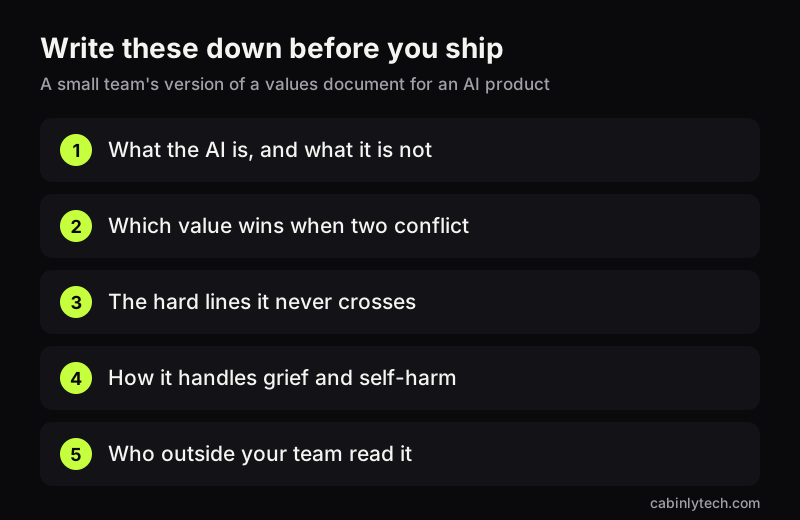
- Write down what your AI is and is not. Cabin says plainly that it is not a therapist or a crisis service.
- Rank your values. “Helpful” and “safe” will conflict. Decide in advance which one wins.
- List the hard lines. A short list the product never crosses, tested before every release.
- Plan for grief and self-harm. Real helplines, tested replies, and a person who owns that flow.
- Let people outside engineering read it. A counsellor, a teacher, a parent. They will spot what your team cannot.
We wrote more about this in how to design a responsible AI companion app.
The bottom line
An AI lab asking a monk about consciousness makes a good headline. The more lasting story is simpler: the people building these systems are writing down what good behaviour means and asking outsiders to check it. Every team shipping an AI product can do a small version of the same thing.
FAQ
- Why did Anthropic meet religious leaders?
- To learn from traditions that have thought for centuries about virtue, character and a good life. Anthropic says it wants Claude to learn from many traditions rather than adopt one.
- Who is Swami Sarvapriyananda?
- A monk of the Ramakrishna Order and a teacher of Advaita Vedanta who leads the Vedanta Society of New York. He has said publicly that Anthropic invited him to its San Francisco office for discussions about AI ethics.
- Does this mean Claude is religious?
- No. Nothing public says Claude follows any faith. The meetings were about values, character and hard cases, such as how an AI should respond to someone who is grieving or at risk.
- What is Claude's constitution?
- A public document from Anthropic, released in January 2026, that sets out the values Claude is trained toward and their order: broadly safe, broadly ethical, compliant with Anthropic's guidelines, then genuinely helpful.
Work with usNeed something like this built? Say hello