How to report a local problem in India so it gets fixed
Say the streetlight on your lane has been dead for three weeks. You mentioned it in the neighbourhood group. Everyone agreed it was a problem. Nobody filed anything, or somebody made one phone call that left no record.
Most local problems stay unfixed for a dull reason. They never reach the person who can fix them in a form that person can act on. That part is mostly in your hands. Here is what to write, where to send it, how long the official channels have to answer, and what to do when they go quiet.
Write it so one person can act on it
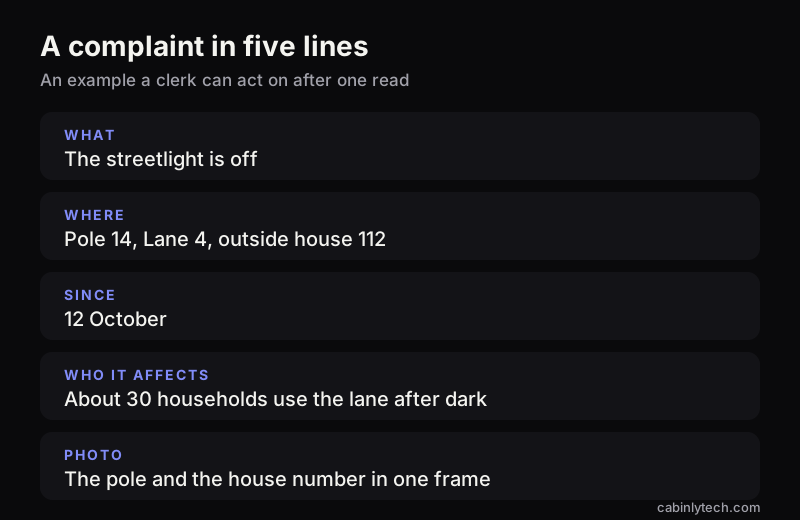
A complaint moves when a clerk can read it once and know where it goes. Give them five things:
- What is wrong, in one sentence.
- Where, exactly. “Near the park” gets lost. “Pole 14, Lane 4, outside house 112” does not.
- Since when. A date turns “it’s always like this” into something that can be checked.
- Who it affects. About 30 households is more useful than “residents”.
- One photo with the problem and a landmark in the same frame.
Keep it to one problem per complaint. A pothole and a dead streetlight are usually different departments, so they need different complaints.
Compare these two. “Street light not working, please fix urgently” tells the office almost nothing. “The streetlight on pole 14, Lane 4, outside house 112 has been off since 12 October. The lane is dark after 6 pm and about 30 households use it. Photo attached” can be forwarded straight to the person who changes the bulb.
Find the right door
Which office owns the problem decides where you file. Roughly:
| Problem | Start here |
|---|---|
| Garbage, sweeping, dirty public spaces | The Swachhata app from the Ministry of Housing and Urban Affairs. You photograph the problem, pick a category and track it. The ministry says city authorities are expected to resolve these within 8 to 48 hours |
| Water, drains, streetlights, roads inside a city | Your municipal corporation or council. Most have a helpline, an app or a ward office. They differ from city to city, so search your city’s name with “complaint” |
| A problem with a government department, central or state | CPGRAMS, the government’s grievance portal. It is free, and you get a registration number to track it |
| Someone could be hurt right now: a live wire, a gas leak | Call 112 first. File the complaint afterwards |
Roads outside city limits often belong to a different body, such as a state public works department or a highway authority. The reply to your first complaint will usually tell you.
What to expect on CPGRAMS
The Centre revised its grievance guidelines in August 2024. Ministries now have 21 days to resolve a grievance. If they need longer, they are supposed to send an interim reply that says why. If you are not satisfied you can appeal, and an appeal is meant to be decided within 30 days. State departments set their own limits, so read what the portal shows for yours.
Keep a paper trail
Whichever door you use, write down three things the day you file: the registration number, the date, and a screenshot of what you submitted. Without a number you cannot follow up, and without a date you cannot say the deadline has passed.
When the deadline passes, write again and quote the number. Then go up one level: the department’s senior officer, then your ward councillor, MLA or MP. Send each of them the same short complaint and the same number, not a new story.
When RTI is the right tool
A Right to Information request is not a complaint. It is a way to ask a question the office has to answer in writing. Good questions are plain: on what date was complaint number such-and-such received, who was it assigned to, and what action was taken?
Under Section 7 of the RTI Act the office must reply within 30 days, or within 48 hours when the information concerns a person’s life or liberty. If you get nothing, or an answer you cannot accept, you can file a first appeal within 30 days to a senior officer in the same office.
The central portal at rtionline.gov.in is for central government bodies. A municipality is a state matter, so use your state’s RTI portal or file on paper. Fees differ by state.
Numbers help
One person’s complaint is easy to close. The same problem reported by forty households is harder to set aside, and it tells the office how big it is. That is the reason we built Hear My Problem.
It is a free public wall for local problems. You post the problem with its place and a type. Neighbours tap Me too, which takes one tap and no sign-in. Every area, city, district and state gets a report that counts problems and people affected, and you can share it as a link or save it as a PDF. You could attach that to your complaint or hand it to your councillor.
One thing it does not do: it does not send your complaint to any office. File the official complaint first, then use the wall to show how many people are behind it.
A few habits that help
- Stay polite and stick to facts. The person reading your complaint did not cause the problem, and a calm complaint is easier to forward.
- Do not name private people or post phone numbers. Describe the problem, not the neighbour.
- Follow up on the date, not when you remember. Put the deadline in your phone.
- Close the loop. When it is fixed, say so on the complaint and on any post you made. It helps the next person.
Start tonight
Write the five lines, take the photo and file the complaint. Note the number. Everything else can wait until you have one.
FAQ
- How long does the government have to answer a complaint in India?
- On CPGRAMS, central ministries have 21 days under the 2024 guidelines. For sanitation complaints on the Swachhata app, the ministry says city authorities should resolve them within 8 to 48 hours. State and city offices set their own limits.
- Where do I complain about a garbage, water or road problem in my city?
- Start with your city's municipal corporation or council, through its helpline, app or ward office. For waste and sanitation you can also use the Swachhata app. If a department does not answer, file on CPGRAMS.
- What is the deadline for an RTI reply?
- Thirty days from the date the office receives your request, and forty-eight hours when the information concerns a person's life or liberty. If you get no reply, you can file a first appeal within thirty days.
- Does Hear My Problem send my complaint to the authorities?
- No. It is a public wall where neighbours can add their voice and where each area gets a report. File the official complaint as well, then use the wall to show how many people are affected.
Work with usNeed something like this built? Say hello